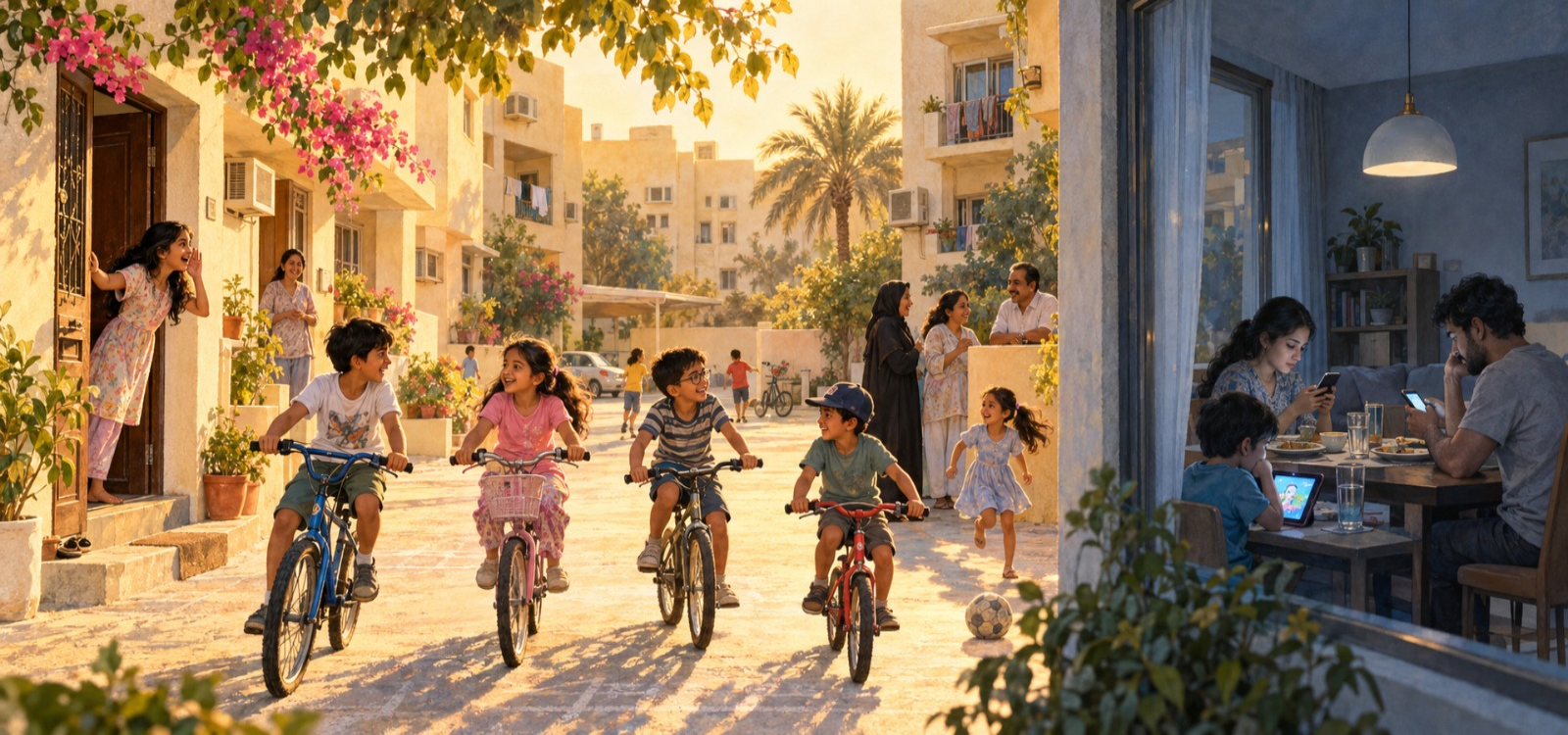
Growing up in Dubai in the ’90s, the most exciting part of my day often began with a knock on the door.
It meant my friends were downstairs, or on their way from another building, and it was time to go out and play.
But first came the familiar afternoon routine: home from school, lunch in front of cartoons on Channel 33, and homework that needed finishing before I could head outside. There was something wonderfully predictable about those afternoons, even though we never quite knew what adventures we would find once we left the house.
We would take our cycles and ride together, race one another, or play hide-and-seek. Friends from different apartments and buildings became part of our everyday world. We did not need elaborate plans. Someone came calling, others joined, and an ordinary afternoon became something we were reluctant to end.
During the shorter public holidays, we would gather in someone’s home, pull out board games, and find ways to keep ourselves entertained. There would be laughter, disagreements over rules, and the inevitable insistence on one more round.
We did not have the internet as part of our daily lives, and cable television was something not every family could afford. Our choices were fewer, but somehow our days felt full.
Looking back, I realise how much of that fullness came from being together.
We knew our neighbours, too. Whether they lived down the corridor, on another floor, or in the next building, they were familiar people with names and families. Our little world extended beyond our own front door. We knew where our friends lived, and a knock was often all it took to bring us together.
Today, it seems entirely possible to live in the same apartment building for ten years and still not know the people next door. We share lifts, corridors, and walls, yet sometimes barely exchange a greeting. I wonder how we became so accustomed to living so close to people while knowing so little about them.
As children, we learned to approach one another, ask to join in, take turns, lose a game, settle an argument, and carry on playing. Sometimes we were bored. Sometimes nobody could agree on what to do. But we had to work through those moments ourselves. Entertainment was often something we created together.
And when we were there, we were there completely.
Today, I sometimes find myself watching a very different kind of childhood unfold.
At restaurants, I notice young children staring at screens while a parent feeds them. I wonder whether they have noticed the taste of their food, the people at the table, or anything happening around them. Among older children and teenagers, conversations can be interrupted by messages, scrolling, or the urge to post something online.
A table can be full of people, yet offer very little conversation.
I find that unsettling. But I also know it would be too easy to turn this into a complaint about children today.
After all, who hands a young child the screen? And what do they see when they look up at us?
How often do we check our phones halfway through someone’s story? How often do we answer a message while insisting that we are still listening? How many of us sit down for a meal with our phones beside our plates, ready to give our attention to whoever is elsewhere?
Children are growing up in a world we have helped shape. If we want them to value presence, they need to experience ours.
I do not remember every afternoon of my childhood as perfect. We had our quarrels, disappointments, and days when there seemed to be absolutely nothing to do. Nor do I wish away the possibilities technology has brought us. I can appreciate being able to stay connected across countries while still wondering what happens when we struggle to connect across a table.
What I miss is the ease with which we once gave an ordinary moment our full attention.
A bicycle ride was enough to look forward to. A friend arriving at the door could change the whole afternoon. We could enjoy something without needing to photograph it, share it, or see whether anyone else approved.
Perhaps we can make more room for that again: a meal during which everyone puts their phone away, an evening of board games, a walk with time to notice our surroundings, or a conversation allowed to continue without interruption. Perhaps it begins with something as small as learning a neighbor’s name.
I cannot recreate the Dubai of my childhood. But remembering it makes me question what we are allowing to become ordinary.
Children being fed without looking up. Families sitting together without speaking. Neighbors remaining strangers for a decade.
Years from now, today’s children will look back on their childhoods, just as I am looking back on mine. I wonder what they will remember about us: the conversations, the laughter, the feeling of being listened to—or how often they had to wait for us to look up.
And if a child’s strongest memory of our presence is having to compete for it, what will we wish we had put down?
